Project Overview
Adaptive Entanglement Generation (AEG) is a deep reinforcement learning–based framework that improves the scalability and efficiency of quantum network routing.
It replaces slow integer linear programming (ILP)–based link selection with Deep Q-Learning, enabling real-time decisions while maintaining near-optimal performance.
In addition, AEG leverages the temporal persistence of entanglement through caching and proactive swapping to significantly improve request success rates.
Key Ideas
- RL-based link selection: Predicts which links to entangle in each time slot, achieving up to 20× faster execution than ILP.
- Entanglement caching: Reuses unused entangled links across time slots, improving throughput by 10–20%.
- Proactive entanglement swapping: Extends entanglement on high-demand path segments ahead of time, yielding up to 107% improvement over baseline routing methods.
Why Link Selection Matters
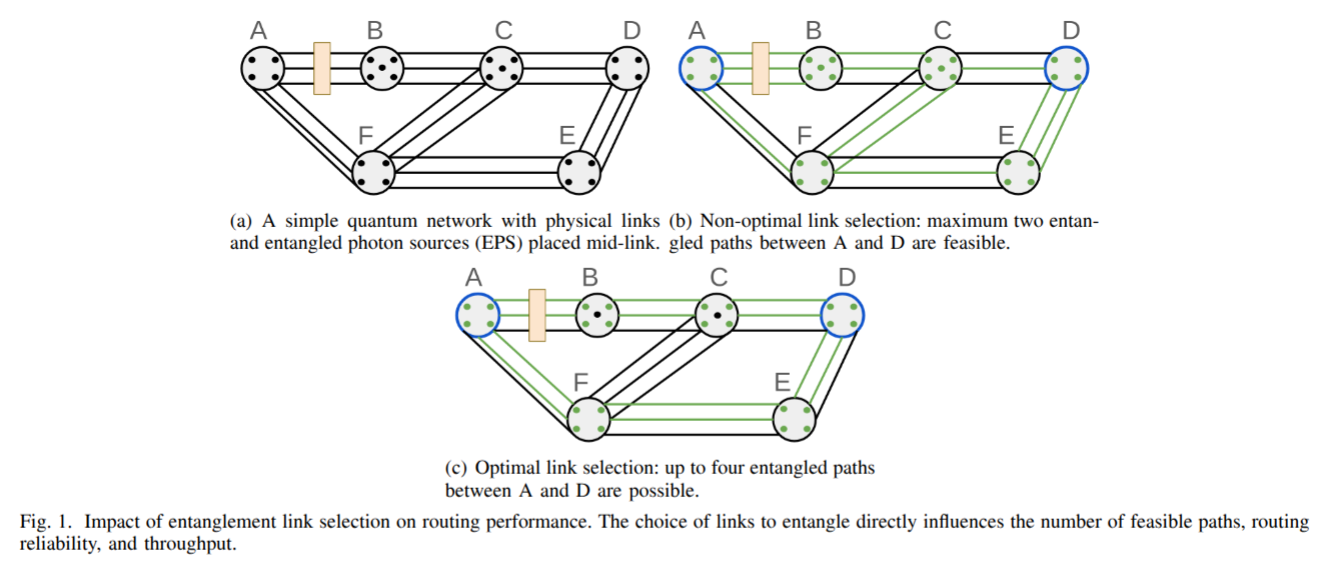
Choosing better links for entanglement generation directly increases the number of feasible end-to-end paths and routing reliability.
Learning-Based Entanglement Control
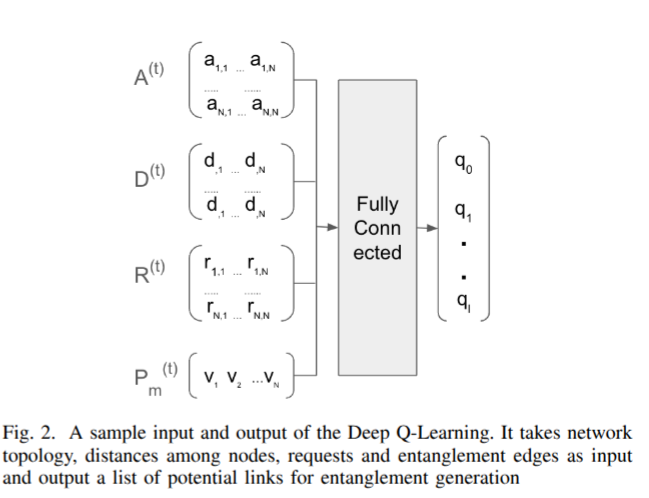
The Deep Q-Learning model takes network topology, distances, and request demand as input and outputs a set of candidate links for entanglement generation in parallel.
Performance Highlights
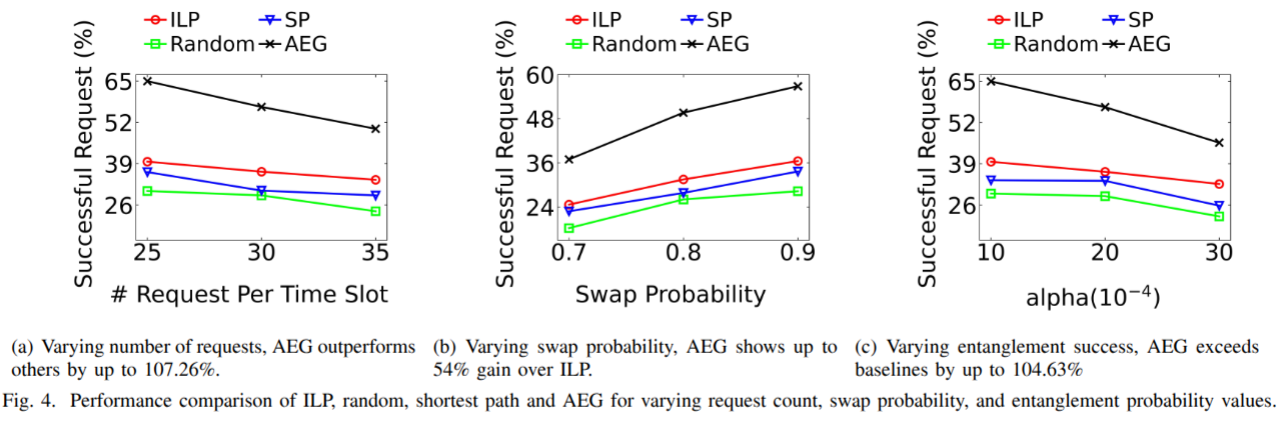
- Up to 107% higher request success rate compared to random and shortest-path methods
- Near-constant runtime as network load increases
- Comparable performance to ILP with orders-of-magnitude lower latency
Preprint: Adaptive Entanglement Generation for Quantum Routing
BibTeX:
@article{islam2025adaptive,
  title={Adaptive Entanglement Generation for Quantum Routing},
  author={Islam, Tasdiqul and Arifuzzaman, Md and Arslan, Engin},
  journal={arXiv preprint arXiv:2505.08958},
  year={2025}
}